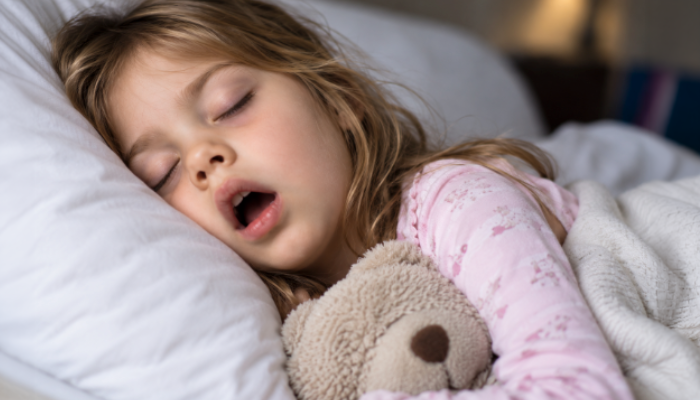
Could clues about your child's breathing and sleep be hiding in plain sight?
Sometimes, they may be visible in your child's smile, facial profile, breathing habits, sleep patterns and even daytime behavior. For parents concerned about pediatric sleep apnea in Knoxville, TN, learning to recognize these early clues can be an important first step.
As parents, we pay attention to our children's growth. We notice when they need bigger shoes. We mark their height on the wall. We watch for new teeth coming in and celebrate when a baby tooth finally falls out.
But there's another type of growth that deserves our attention: the development of your child's mouth, jaws and airway.
The way a child's face and jaws develop can affect much more than the appearance of their smile. These structures are also part of the bigger picture when healthcare professionals evaluate a child for possible sleep-disordered breathing or obstructive sleep apnea.
At TLC Dental Care in Knoxville, Tennessee, Dr. Terrie Cribbs looks beyond teeth and cavities. She evaluates how a child's teeth, dental arches, bite, jaws and facial structures are developing and watches for clues that may indicate a need for further evaluation.
The 5-Second Pediatric Sleep Check is a simple way for parents to become more observant of possible signs of growth, airway or sleep concerns.
Take a quick look at six things:
None of these observations can diagnose pediatric sleep apnea. Instead, think of them as clues that may tell you it's worth looking more closely.
This one surprises many parents.
Take a look at your child's smile. Are there spaces between the baby teeth, or are the teeth packed tightly together and touching?
Baby teeth are smaller than the permanent teeth that will eventually replace them. As children grow, their jaws and dental arches also develop.
If your child's primary teeth have very little or no space between them, Dr. Cribbs may want to take a closer look at the size of the dental arches and the amount of room available for the larger permanent teeth that will eventually erupt.
A lack of spacing does not mean your child has sleep apnea or an airway problem. It is simply one observation that can help a dentist evaluate your child's overall dental and facial development.
The American Academy of Pediatric Dentistry considers evaluation of the developing dentition, arch length, crowding, skeletal relationships and facial profile important components of assessing a growing child.
Now have your child stand naturally and look at them from the side.
Pay particular attention to the relationship between the forehead and chin.
Does the chin appear to sit well behind the forehead, making the lower jaw look set back?
The relationship between the upper and lower jaws is part of normal facial growth and development. Jaw position and other craniofacial characteristics are also among the factors healthcare professionals may consider when assessing a child's risk for sleep-related breathing problems.
This isn't something parents should try to diagnose from a profile.
Instead, you're simply learning to notice how your child is developing.
If Dr. Cribbs sees a facial profile or jaw relationship that concerns her, she can evaluate your child's bite, dental arches, jaw relationships and growth pattern more closely.
Here's an easy one to observe.
Watch your child while they're relaxed—watching television, reading, doing homework or riding in the car.
Are their lips comfortably together, or is their mouth frequently hanging open?
Now think about nighttime.
Does your child sleep with their mouth open?
An occasional open mouth isn't necessarily concerning. Every child gets a stuffy nose occasionally.
We're looking for a pattern of persistent mouth breathing.
Mouth breathing is one of the symptoms healthcare professionals consider when screening children for obstructive sleep apnea and other forms of sleep-disordered breathing.
If your child routinely breathes through their mouth during the day or sleeps with their mouth open, it's worth mentioning to their dentist and pediatrician.
Some parents notice that their child frequently has dark circles under the eyes—even when it seems like they've had plenty of time to sleep.
Dark circles can have many different causes and do not mean a child has sleep apnea.
But Dr. Cribbs doesn't look at one symptom in isolation.
If dark circles appear along with chronic mouth breathing, snoring, restless sleep, or concerns about facial or dental development, they become another observation worth discussing.
Think of it like a puzzle.
One puzzle piece doesn't show you the picture. Several pieces together may begin to.
A child can spend nine or ten hours in bed and still not necessarily be getting consistently restful, restorative sleep.
That's why it's worth occasionally watching how your child sleeps rather than simply counting the hours.
Signs worth discussing with your child's healthcare provider include:
These are among the symptoms healthcare professionals may consider when screening children for obstructive sleep apnea and other sleep-related breathing disorders.
If you repeatedly witness your child stop breathing, gasp, choke or struggle to breathe while sleeping, contact your child's healthcare provider rather than relying on an at-home screening.
This is one of the most important things for parents to understand about sleep apnea and sleep-disordered breathing in children.
Children don't necessarily respond to poor sleep the way adults do.
An exhausted adult may drag through the day dreaming about a nap.
A poorly rested child may appear inattentive, irritable, emotional, impulsive or unusually active.
Ask yourself:
These symptoms have many possible causes. Sleep-disordered breathing is only one possibility.
However, the American Academy of Pediatric Dentistry notes that untreated pediatric obstructive sleep apnea can be associated with learning and behavioral problems, and some children may be incorrectly diagnosed with ADHD.
That makes sleep an important part of the conversation when a child is struggling during the day.
Signs and symptoms associated with pediatric obstructive sleep apnea can include frequent loud snoring, mouth breathing, restless sleep, frequent waking, unusual sleeping positions, difficulty breathing during sleep, witnessed pauses in breathing and daytime attention or behavioral problems.
Having one of these symptoms does not mean your child has sleep apnea.
When several signs occur together or persist over time, however, further evaluation may be appropriate.
A dentist can play an important role in screening children for signs that may indicate an increased risk of obstructive sleep apnea, but a dental screening is not a diagnosis.
Dentists have a unique opportunity to regularly observe a growing child's teeth, bite, dental arches, tongue, oral structures, jaw relationships and facial development.
When a child appears to be at risk, referral to an appropriate medical provider—such as an ENT, sleep medicine physician or pulmonologist—may be recommended. A sleep study may also be necessary to determine whether obstructive sleep apnea is actually present.
Your child's mouth can provide valuable information about growth and development.
At TLC Dental Care in Knoxville, TN, Dr. Terrie Cribbs evaluates more than whether a child has cavities.
She looks at the developing teeth and bite, dental arches, jaw relationships, oral habits, breathing patterns and facial development as pieces of a much larger picture.
The goal isn't to diagnose sleep apnea from the dental chair.
The goal is to recognize clues early enough to ask the right questions.
Consider talking with Dr. Cribbs and your child's healthcare provider if you notice a persistent pattern of several signs, such as:
Your child regularly breathes through their mouth, snores frequently, sleeps restlessly, has a lower jaw that appears set back, has tightly spaced primary teeth, and is experiencing daytime attention or behavioral concerns.
No single item on that list provides a diagnosis.
But taken together, those observations may warrant a closer look at your child's dental and facial development, airway and sleep.
Tonight, take a fresh look at your child.
Look at their smile. Are the baby teeth tightly together, or do you see spaces?
Look at their profile. Where does the chin sit in relation to the forehead?
Watch them breathe. Is their mouth frequently open?
Look under their eyes. Do you regularly notice dark circles?
And sometime after they've fallen asleep, peek into their room.
Are they sleeping quietly and comfortably—or snoring, mouth breathing, tossing and turning?
Finally, think about the child you see during the day. Have there been changes or concerns involving attention, behavior, mood or school performance?
You know your child better than anyone.
Sometimes the first step toward identifying a potential problem isn't a complicated test.
It's knowing what to look for.
If you've noticed several of these signs or have questions about your child's dental, jaw or facial development, talk with Dr. Terrie Cribbs at TLC Dental Care in Knoxville, Tennessee. She can evaluate what she's seeing from a dental and developmental perspective and help determine whether further evaluation is appropriate.
Yes. Obstructive sleep apnea occurs in children as well as adults. Symptoms can include frequent loud snoring, mouth breathing, restless sleep, unusual sleep positions, difficulty breathing during sleep, witnessed pauses in breathing and daytime attention or behavioral problems.
Occasional snoring can happen, particularly when a child is congested. Frequent or loud snoring—especially when accompanied by mouth breathing, restless sleep, gasping, pauses in breathing or daytime concerns—should be discussed with your child's healthcare provider.
Persistent mouth breathing is one of several symptoms healthcare professionals consider when screening children for obstructive sleep apnea and other sleep-related breathing disorders. Mouth breathing can have multiple causes, so it should be evaluated in context with the child's other symptoms and development.
Spacing in the primary dentition provides room as a child's dentition develops and larger permanent teeth begin replacing baby teeth. If a child has very little spacing or significant crowding, a dentist can evaluate arch length, available space, bite and overall dental development.
Poor-quality sleep and pediatric obstructive sleep apnea can be associated with attention, learning and behavioral problems. These concerns can have many causes, which is why sleep should be considered as one part of a comprehensive evaluation.
If you recognized some of these signs in your child, don't ignore what you're noticing.
At TLC Dental Care in Knoxville, TN, Dr. Terrie Cribbs looks beyond the teeth to evaluate your child's developing smile, dental arches, bite, jaw relationships and other clues that may be connected to how they breathe and sleep.
Sometimes, several small signs can add up to a bigger picture.
Schedule an evaluation with Dr. Cribbs and find out whether your child's growth and development deserve a closer look.
Call TLC Dental Care at (865) 247-5570 to schedule an appointment.